
|
||||||||||||||||||||||
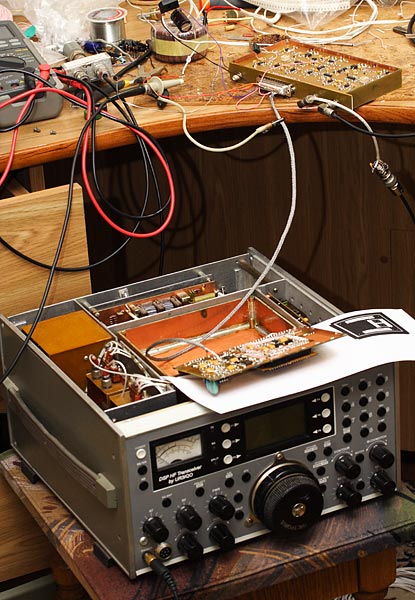
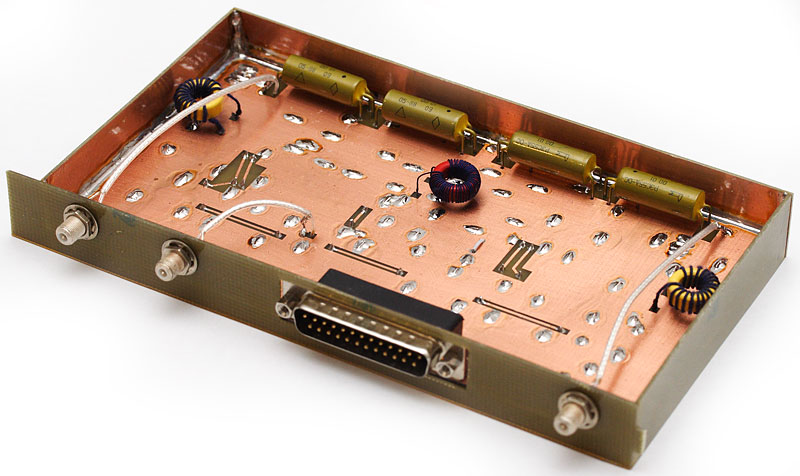
The IF UnitThe IF Unit contains two first IF amplifiers and two quadrature mixers (for the two receivers). The TX mixer and TX IF amplifier are also there. My old transceiver T03DSP uses the same ADC CS5381 in its DSP Unit as the Neon. When the IF Unit was ready for testing the Noen's DSP unit was not yet assembled, so I decided to tempararily wire the IF Unit to the T03DSP's DSP Unit to measure its parameters. A special firmware was loaded to the DSP Unit to measure IF Unit parameters.
The first results were very good. When the new DSP unit was ready I repeated measurement. It appeared that the new DSP Unit had much better ADC DR, so some level optimization was made. The IF amplifier MMIC was changed (initially I used SGA-7489, it was replaces by the lower gain part - SBF-4089). Also the post IF amplifier attenuator was tweaked for the optimum gain distribution. Finally I got the following parameters for the combined IF Unit and ADC (CS5381). IP3i=+27dBm, NF=5.4dB (MDS=-141.6dBm@500Hz BW). -8dBm input signal produces FS signal at the ADC. The image rejection is 49dB. Note that image rejection is not a problem here - the main purpose of the quadrature second mixer is to reject the first IF amplifier noise in the image passband (otherwise the IF amplifier NF will be degraded by 3dB), so everything more then 20dB is sufficient. As the bonus we get 3dB more dynamic range and additional second IF image rejection (the first IF xtal filter provides the most of the necessary image rejection already). The parameters of the complete IF Unit, corresponds to 13dB second mixer noise figure. The calculated IP3i of the complete Neon frontend at a very close signal separation (two tones inside the first IF roofing filter) should be near +34dBm with NF=12..13dB. This corresponds to DR3 (at 500Hz BW, with both tones inside the roofing filter passband) of 112dB (!). I do not know any commercial rig that has such performance. Some words about schematics. The first IF amplifier is built on the Sirenza InGaP/GaAs MMIC gain block SBF-4089. It provides a low noise figure (NF approx. 3.5dB), the necessary gain (G=+15dB) and excellent linearity (IP3o>+40dBm at 5MHz). The 3dB attenuator provides better loading for the IF amplifier (this improoves the amplifier linearity) and sets the required IF chain gain. The mixer is double balanced switching type circuit. The switches connected to the virtual ground points of the fully differential opamps (OPA1632), so the voltage at the switch is fairly constant and does not changes with the input signal (it improoves mixer linearity). The idea to connect switches to the virtual groud came from the SM5BSZ RX2500 mixer. The measurements showed the IP3 performance of the mixer was determined by the ADC. The mixer has two channels operating in quadrature. Such design has some advantages - it provides 3dB higher dynamc range and suppresses the first IF amplifier noise coming through the second IF mixer image passband.
The IF Unit schematics can be downloaded Table 1. The IF unit performance
+ - two -20dBm test signals with 4kHz separation ++ - two -5dBm test signals with 4kHz separation The IP3 values remained fairly constant with different (1..10kHz) test tones separation.
|


All materials provided here are copyright by Oleg Skydan UR3IQO (unless otherwise explicitely specified). In all cases, materials are
provided for the purpose of self education
and training in Amateur Radio. No use may be made for commercial purposes without
permission of the author.
Please send any comments and questions to Oleg Skydan UR3IQO.
This page was last updated on 10.09.2020 06:49